Long Distance Movers in Enid, OK
Enid Movers plans long-distance moves from Enid to another state or across the country, for family homes, apartments and small offices. Census figures count 2,285 residents who arrived from another state within a single year, so the road runs both ways. A long haul calls for a written inventory, pads on every piece and crates for breakables. Tell us both ends of the trip and how much is coming.
When a move becomes long-distance
It means crossing a state line, or covering enough ground that pickup and drop-off fall on separate days. That sets it apart from a local move in three practical ways: the schedule runs on a delivery window, your goods are weighed or measured and written up closely, and federal rules give you rights to lean on. A move that stays inside Oklahoma answers to the Oklahoma Corporation Commission instead.
The rest of this page shows how to put that to work.
The question everyone asks: when will my things show up?
Interstate shipments come with a delivery spread, a span of possible days instead of one fixed date. That is standard practice, not an excuse. A truck covering two thousand miles deals with weather, legally required rest breaks for its driver and other households' goods on board, so an exact arrival hour that far off is something nobody can honestly offer.
You should hear the spread before you sign, not once the truck has pulled away. Ask how long it is, what happens if it runs over and how you'll get updates on the road. Ahead of an interstate move, FMCSA rules have movers hand you the Your Rights and Responsibilities When You Move booklet, so read it. A shared trailer usually means a longer spread than a dedicated one.
What follows from that is the step most people skip: plan to live at the new address for the whole spread without your furniture. There's more on that further down the page.
Where the cost comes from
A long haul is priced on other factors than a short move across town:
The size of your shipment.
This weighs heaviest, and it's also the one you control best: whatever stays behind is weight that never needs hauling at all.
Miles, and the destination.
Mileage, yes, but the route counts too: a drop near a main highway corridor is a different job from a farm address far from any interstate.
Steps and long carries.
At the pickup and the drop-off.
How much of the packing you hand over.
Details on packing services.
The calendar.
The summer months and the last days of any month fill first across the industry, so book further out.
Add-ons.
Crates for art, stone and glass, storage between pickup and delivery, additional stops at either end, and shipping a car.
Reaching each door.
Where the big trailer can't reach the house, legally or physically (a tight street, low limbs or a low bridge, a sharp corner, a steep or gravel drive, a road with a weight limit), the load moves onto a smaller truck for the last stretch. The trade calls that a shuttle. It happens often and is among the most common nasty surprises at delivery, so raise it while you're collecting quotes and describe both streets accurately.
What to ask every long-distance mover you call
Of everything here, these questions do the most good. Put each one to us and to every other mover on your list:
Carrier or broker: which are you?
A broker passes your move to a trucking company you've never met or checked. Both are legal, but find out which one you're dealing with before any deposit changes hands.
May I have your USDOT number?
Interstate household goods movers each hold one. Look it up through the Federal Motor Carrier Safety Administration to see its authority and any complaints filed against it.
Is the estimate binding, not-to-exceed or non-binding?
The three types play out very differently once the real shipment weighs more than the estimate did. Ask for the answer on paper.
Does anyone look at the house first, on site or on video?
A figure worked out without anyone seeing the goods is a guess, and guesses tend to change on the morning of loading.
How long is the delivery spread, and what if it runs over?
Cross-country shipments get a span of delivery days rather than one date, and that span goes into the contract. Find out its length, the day it begins and what the mover does once it's exceeded.
Will other households' goods ride on the same trailer?
On most long hauls they will, and that's normal, not a red flag. It still matters, because sharing space is exactly why you get a span of days instead of one date.
Could either address need a shuttle?
Bring this up during the quoting stage. When the big trailer can't get to one of the addresses, your goods move to a smaller truck, and it's much better to learn that early than on the day your things arrive.
How big a deposit do you want?
A small deposit is normal. A big one demanded up front, or pressure to pay before the terms are written down, calls for a second quote.
How are my belongings protected, and what would the higher level of cover add?
Basic liability on an interstate move pays out far less than people tend to expect. Ask how it's worked out before deciding whether to pay for more.
What a well-packed long haul looks like
A move across the country is more than a longer drive: days of road vibration, transfers between trucks or docks, and other families' goods packed in beside yours. Preparation has to change to match:
Each item gets listed, with its condition noted, before it's loaded
That's what lets you compare what left with what turned up. Walk through that list yourself at delivery, before you sign for anything.
Pads taped or banded in place, not just thrown over.
A loose pad that falls away on day one protects nothing for the rest of the trip across the country.
Crates for marble, stone, mirrors, glass and art
They aren't simply wrapped. A stone top is weak across its face and can crack after days of vibration lying flat.
Cartons, not plastic, for mattresses
For a long trip, that is. A bag does fine across town and wears through over a week of rubbing.
Straight talk about flat-pack pieces.
Particleboard that has been taken apart once already seldom justifies its shipping weight over a long distance, and it often turns up out of square. A good mover tells you that before loading it, rather than leaving you to discover it on arrival.
TVs and screens stand upright
Each screen in its own fitted carton, never flat under a load.
A load that can't shift.
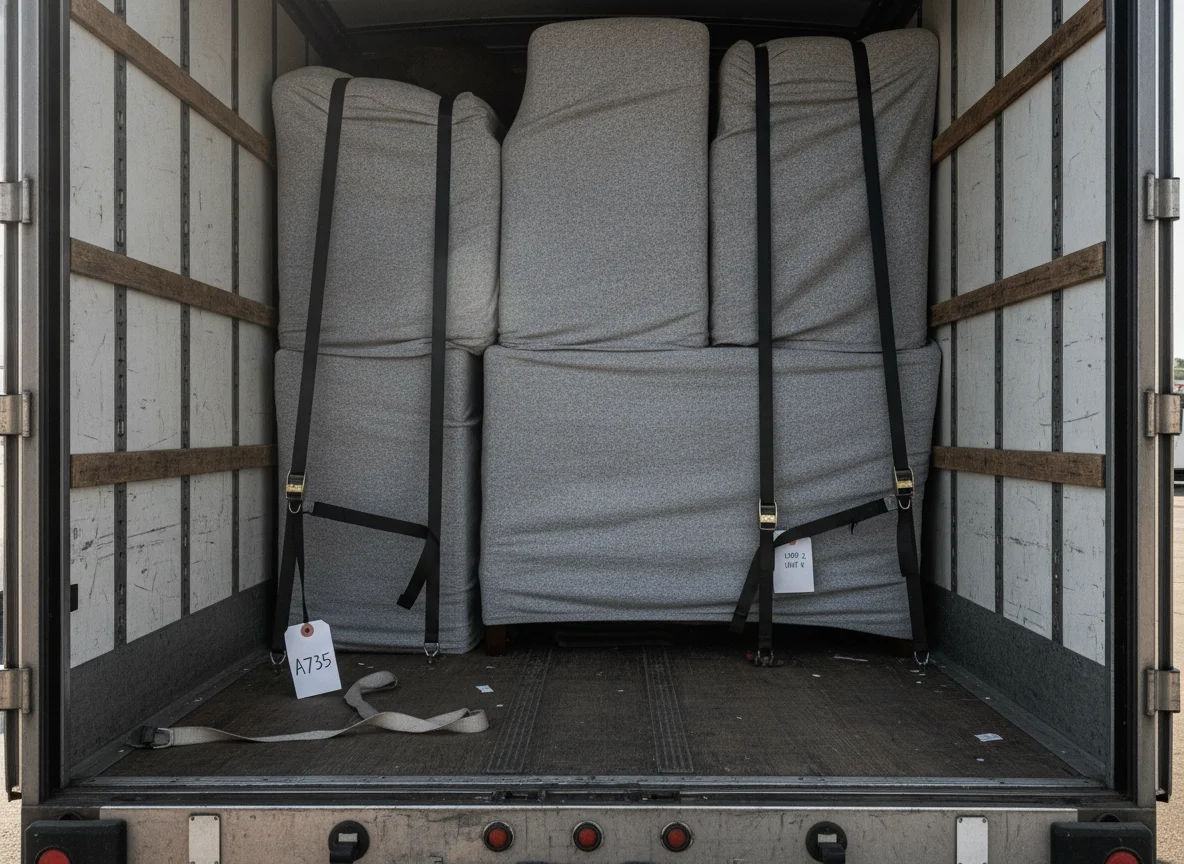
Heavy boxy pieces go low against the trailer walls, cartons are stacked tight and strapped, and nothing is left loose to slide on a curve.
Items a mover won't haul
Fuel, chemicals and explosives
Fuel, propane, thinner, aerosols, pool chemicals, ammo and fireworks stay off; drain mowers. Enid's landfill takes household hazardous waste on up to six trips a year.
Food that can spoil.
A trailer on the road for a week won't keep anything cold.
Houseplants.
Some states check or turn back plants at the border to protect crops, and most plants die in a dark trailer regardless.
Animals.
They ride with you, never in the trailer.
Things you can't replace.
Papers, passports, prescriptions, jewelry, laptops, hard drives, keys and keepsakes belong in your own car. If losing an item would wreck the whole move, keep it off the truck.
Before the truck
Clear out before packing, not at the other end. Every carton on a long haul adds to what you spend, so the cheapest box is one you never fill. Enid residents with a City utility bill get up to 12 landfill trips a year, which makes the clear-out easier.
Take photos of anything valuable before it gets wrapped, and write down serial numbers for electronics. An hour of that keeps any later talk about condition brief.
Plan for the in-between days. From loading day to delivery day you still have to live: clothes suited to the weather where you're going, prescriptions, chargers, work gear, school supplies, sheets, some kitchen basics and your move paperwork. All of it rides in your car or suitcase, never on the truck. Skip this and you end up buying everything twice.
Mark each carton with the room it's headed for, and keep your own list next to the mover's.
Long-distance moves leave from all over the Enid area: Blanton, Downtown Enid, North Enid, Waukomis, Breckenridge, Carrier and nearby towns.
Things people ask
When should I reserve a long-distance move?
Sooner than a local one. Interstate work gets slotted into a route, not just a day, so the earlier you call, the more choice you have about loading day. Summer and the turn of each month are the most crowded times on the calendar, so plan with those in mind.
What about shipping my car?
Cars usually travel apart from the household goods, on another truck and often on their own schedule. Bring it up early instead of at the last minute, since it changes how you'll get yourself and your family to the new place.
What if the new home isn't ready on delivery?
It happens a lot, and the answer is storage between pickup and delivery. Mention it the moment a gap looks possible; storage booked ahead is simple, while storage sorted out on delivery day is anything but.
Is packing myself an option?
It is, and many people do it to keep the bill down. Liability on a box you packed yourself is often handled differently from one the mover packed, so ask how that works before deciding which boxes you'll do on your own.
Planning the move?
Share both addresses, a rough timeline, the number of bedrooms and anything large or delicate that needs extra planning. That's plenty to begin with.